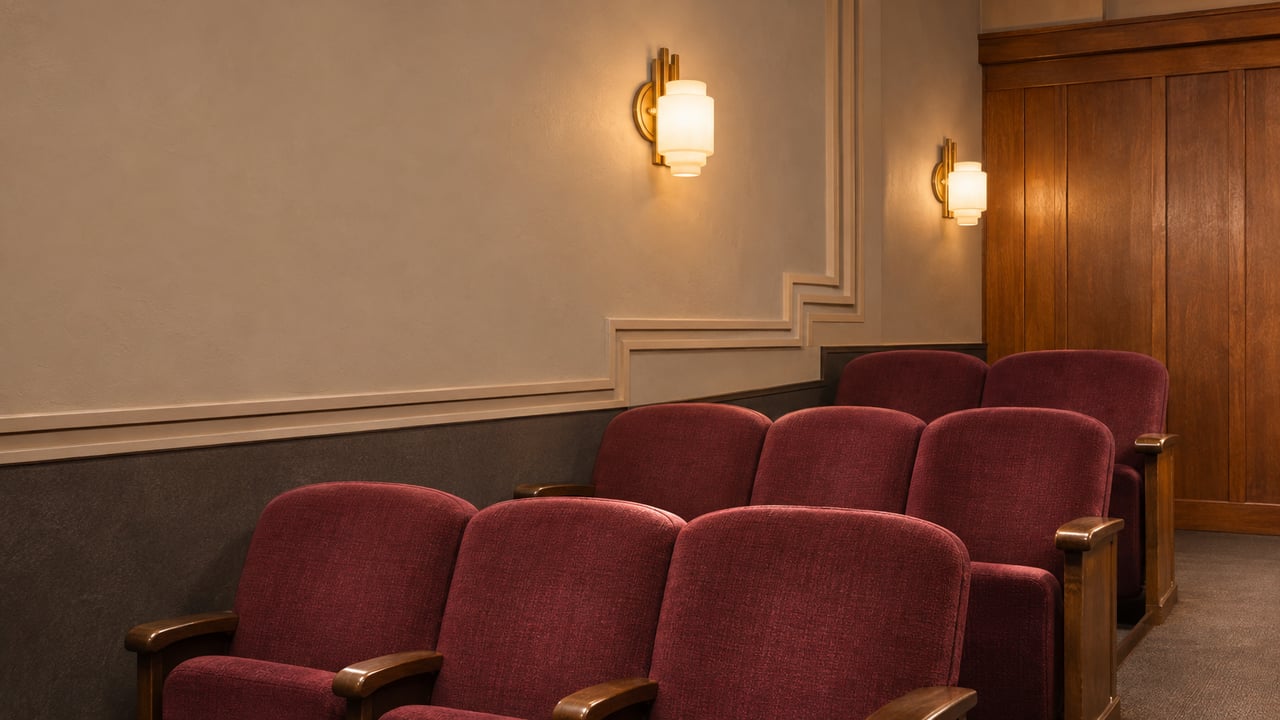
The Cerrito Theater Sat Dark for Four Decades. Twenty Years After Reopening, It Has Outlasted the Chain Screens Around It.
November 12, 2026
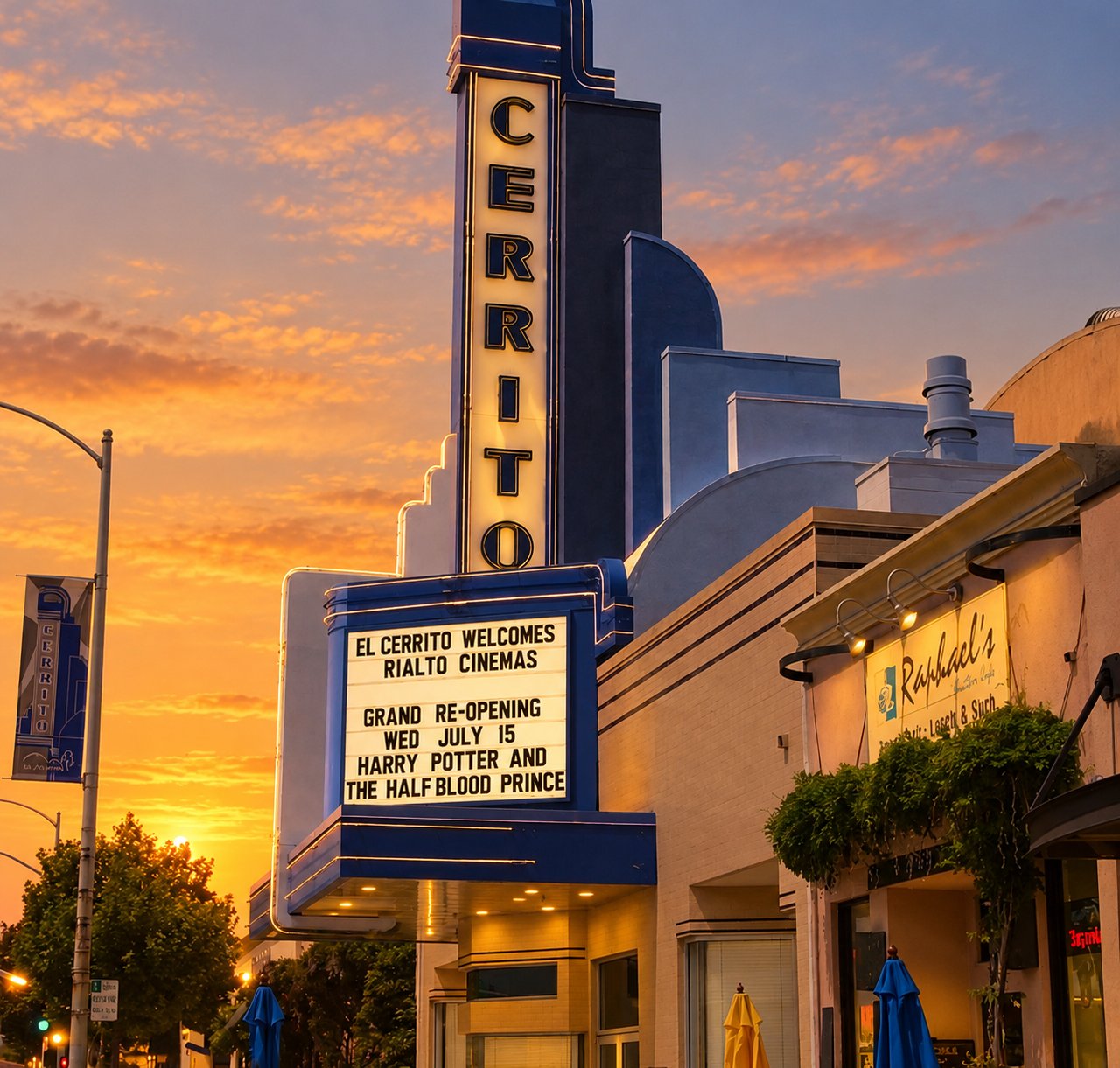
On May 3, 2002, the City of El Cerrito opened the doors of a furniture warehouse on San Pablo Avenue and invited people in to look at the walls. About 3,000 came, according to a 2006 SFGate report, in a town of about 21,000. They came for the silver-leaf murals of dancing gods and goddesses that still ran around the proscenium of a 644-seat movie house most of the town had forgotten. The marquee blade and the ticket booth were long gone. To most people walking past, the barrel-roofed building at Central and San Pablo did not look like a theater at all.
Four and a half years later, on November 1, 2006, the restored Cerrito Theater reopened with "Casablanca" and "Pulp Fiction." It turned 20 this month as Rialto Cinemas Cerrito. Since 2020, most of the commercial screens between here and downtown Berkeley have gone dark. The theater that spent the longest time closed is the one still open, and the way El Cerrito saved it explains why.
The Cerrito opened on Christmas Day 1937 with a double bill of "Hoosier Schoolboy," starring Mickey Rooney, and "Thin Ice," with Sonja Henie and Tyrone Power, the San Francisco Chronicle recounted in its anniversary piece. Its architect, William B. David, had trained in the office of the streamline moderne theater designer S. Charles Lee. David did not try to build an Oakland Paramount. The Friends of the Cerrito Theater history describes a deliberately small neighborhood venue with an oval "jewel box" lobby, Deco chandeliers and sconces, porthole doors with blue etched glass, and a blue mirror etched with the goddess Diana drawing her bow.
The murals are still the main attraction. Dancing warriors and maidens, Zeus with his thunderbolts and skipping harlequins climb over the stage and run down both sides. The Friends group says it has never confirmed who painted them, though it raises the possibility that the work came out of the studios of the muralist Anthony Heinsbergen.
Movie ads for the Cerrito disappeared from local papers in 1963. In 1966 the owner sold the building, and it spent the next several decades storing furniture. SFGate put the closure at 1962 and the warehouse years at "nearly four decades." After that, a developer bought the building and sold it to the city.
The rescue followed a sequence that most theater campaigns never finish:
Not everyone agreed with the plan. SFGate's 2006 report noted complaints about the cost and about the city waiving parking requirements for the project. Even so, public ownership put the building in the hands of people who wanted a theater there, and the 2018 sale was built to keep it that way. The Friends group wrote after the vote that the approval meant the building would keep operating as a theater, with its historic elements intact, for the next 99 years. City officials pushed the sale through in the board's final meeting, a week after council approval. They wanted it decided by a local board before a countywide body took over that July. In a December 2024 interview, the San Francisco Bay Times described Rialto director Ky J. Boyd as the owner and operator of the Cerrito, the Elmwood in Berkeley, and Rialto's flagship in Sebastopol.
Over the same years, the nearby theaters run by national chains went dark one after another.
| Theater | Operator | Closed | Reason given in local reporting |
|---|---|---|---|
| California Theatre, Berkeley | Landmark | After March 2020 | Falling ticket sales, the pandemic, streaming |
| Shattuck Cinemas, Berkeley | Landmark | May 2022 | Falling ticket sales, the pandemic, streaming |
| Regal UA, Berkeley | Regal | February 2023 | Falling ticket sales, the pandemic, streaming |
| Albany Twin, Solano Avenue | Landmark | June 15, 2023 | No new lease agreement with the property owner |
The Albany Twin is the closest comparison. It had screened movies on Solano Avenue for more than eight decades, in a 1920s building that started out as a meeting and dance hall. Berkeleyside reported in June 2023 that its general manager said it was closing because Landmark could not reach a new lease agreement with the property owner. The year before, it had hosted the Albany FilmFest and the East Bay portion of the San Francisco Jewish Film Festival, and he said both were well attended. Audiences were still coming. The lease could not be renewed.
The Cerrito has never faced that problem. Its building was bought by the public and then sold to its operator with a requirement to keep showing films. Berkeleyside wrote in July 2024 that Rialto Cinemas Elmwood was by then the only commercial theater left in Berkeley. As of that summer, both of Rialto's East Bay theaters were still showing films.
Owning the building does not cover the bills on its own, and Boyd has said the Cerrito's setup affects what ends up on its screens. He told the San Francisco Bay Times:
"The Cerrito, because it has a full kitchen and thus higher overhead, is the most straight-up commercial of our three theaters because it needs hits to maintain its overhead."
In the same interview he called the Cerrito Rialto's introduction to food, beer and wine service. He said it had influenced how the company developed its other two theaters, and that the restoration made the Cerrito the most beautiful of the three. He described the Elmwood, by contrast, as the "truest arthouse" of the group. The kitchen the city paid to install in 2006 is the reason El Cerrito's theater leans toward first-run releases.
The seat count changed with the business. The 1937 Cerrito held 644 seats under one roof. Today Auditorium 1 seats 141 and Auditorium 2 seats 137, according to Rialto's rentals page. Rialto also turned an underused storefront area into a 21-seat screening room to widen its programming. That makes 299 seats across three rooms, fewer than half the original count, spread over three screens where there used to be one.
The current lineup mixes first-run releases with independent, foreign and classic films. It also carries captured stage and arts broadcasts, including Exhibition on Screen programs and the Met Opera Live in HD 2026-27 season. A few practical details from Rialto's own pages:
The Friends of the Cerrito Theater and the El Cerrito Historical Society built the November 9 anniversary evening at the theater around a free screening of Rustin Thompson's documentary "The Last Pictures Shows," about cinephiles preserving movie theaters across the western United States, with a Q&A with Thompson planned after the film. The film is about the same kind of effort that filled a furniture warehouse with 3,000 visitors in 2002. If you want to see the murals that started it, they are still over the stage at 10070 San Pablo Avenue, at the corner of Central.
For more on how this side of town is changing, read our look at the six days in November that explain El Cerrito's whole year, or browse our El Cerrito neighborhood page.
Places like the Cerrito are a big part of why people stay in this corner of the East Bay, and we pay close attention to them when we help clients buy and sell near San Pablo Avenue. If you want to know what living a few blocks from the theater is worth in today's market, Sallat & Perry Group would be glad to walk you through it. Schedule a Consultation.
Stay up to date on the latest real estate trends.

Whether you’re buying your first home or listing a cherished property, Sallat & Perry Group brings unmatched East Bay insight and a personalized strategy to every transaction.