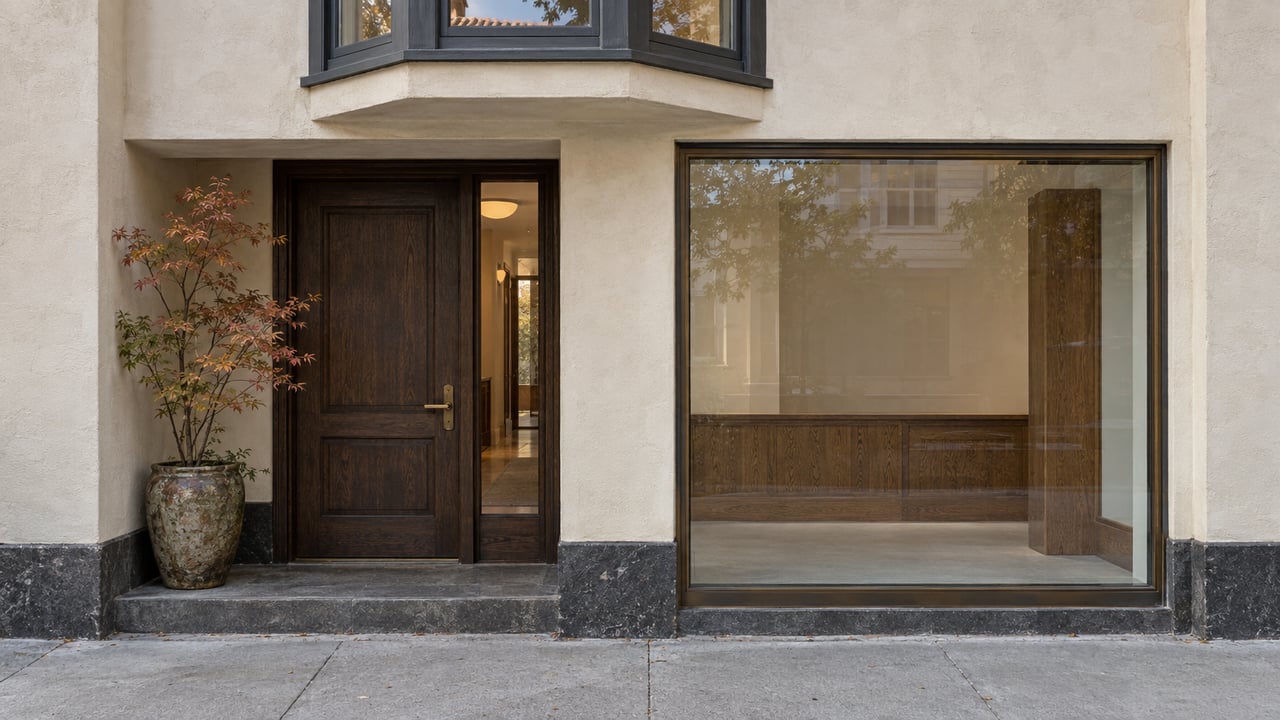
Every Third Thursday, Piedmont Avenue Runs the Same Test. Two New Storefronts Are About to Take It.
October 1, 2026
October 1, 2026
Piedmont Avenue keeps one appointment that never moves. On the third Thursday of every month, storefronts between Broadway and Pleasant Valley Avenue stay open past their usual hours, string up a little extra light, and let the sidewalk fill with people who came for art but stayed for the fact that everyone else came too. It is the kind of tradition that survives because almost nothing on this strip ever needs replacing. That is what makes this fall's Art Walk worth paying attention to: for the first time in years, the ritual has to make room for tenants who have never stood behind a Piedmont Avenue counter before.
The Piedmont Avenue Art Walk is organized by the Piedmont Avenue Merchants' Association, a volunteer-run group that has represented business owners on this stretch since 1939. PAMA runs the walk from 6 to 9 p.m. on the third Thursday, and the format has stayed simple for as long as anyone can remember: participating shops open their doors late, hang art on the walls, bring in a musician or two, and pour something to drink. It is not a festival that arrives once a year and leaves a mess behind. It is a monthly habit, low-key enough that a regular could set a watch by it.
Part of why the walk works is that Piedmont Avenue does not behave like most Oakland commercial corridors. Longtime observers of the strip describe it as one continuous run of shops and restaurants with almost no empty storefronts in between, which is unusual enough in this city to be worth noting on its own. The anchors are not new. Fentons Creamery has been serving ice cream since 1894 and picked up a cameo in Pixar's Up along the way. Commis, a few doors down, holds a Michelin star. The Piedmont Theatre has been running film since 1917, which makes it Oakland's longest continuously operating cinema. Spectator Books has been in business since 1994, under its current owners since 2017. None of these places opened this year. None of them are likely to close next year either.
That stability is exactly why a genuinely new storefront on this street is an event, not background noise.
For most of the last decade, there was one real gap in that continuity: a parcel that BayRock, a Bay Area developer, bought through an off-market deal in October 2018. The site needed a year-long entitlement process with the city and a remediation plan cleared through Alameda County's environmental health services before anything could rise on it. What eventually went up is One Piedmont, a six-story building with 57 apartment homes, including three set aside for very low income households, wrapped around 6,000 square feet of ground-floor retail meant to serve both the neighborhood and the much larger daytime population that flows in from the nearby Kaiser medical campus.
The residential floors reached stabilization in the third quarter of 2025. The retail space took longer to fill, which is normal for ground-floor commercial space in a new building. According to the project's own developer materials, two food establishments were slated to open on that ground floor in the first quarter of this year. That timeline puts their arrival squarely inside the Art Walk's usual rhythm of new participants finding their footing on a street where the surrounding businesses have decades of head start.
Whatever those two tenants turn out to be, they are stepping onto a corridor that has spent close to a century figuring out how to keep an audience coming back every third Thursday without needing to reinvent itself to do it.
The Art Walk does not exist in isolation. It sits inside a weekly pattern that residents already move through without thinking about it much. Kaiser Oakland hosts a farmers' market on Friday mornings, a fixture separate from the Thursday evening walk but part of the same texture of a street that gives people a reason to be outside on foot more than once a week. Cato's Ale House keeps its TVs on for sports on any given night. Doña Tomás serves Mexican cuisine in a dining room that changes its menu with some regularity. Geta packs a full Japanese menu into a space small enough that big parties are not really the point. None of that changes because two new storefronts are filling in at One Piedmont. It is the backdrop those two spaces are now part of.
What changes, subtly, is the composition of Third Thursday itself. For years, the walk's participant list has been close to a known quantity: the same shops, the same handful of new works on the walls, the same musicians rotating through. A pair of first-time tenants on a stretch that essentially never has vacancies gives this fall's walk something the last several did not have, which is an actual unknown. Third Thursday gives the newcomers an easy first introduction to the street, since the format already invites any shop or restaurant to stay open late, hang local art, and pour something for the crowd.
None of this is really about square footage or a construction timeline. It is about what happens when a street that has spent nearly a century training its merchants and its customers into the same monthly habit finally gets new blood in a building specifically designed to add foot traffic from a much bigger population next door. The Kaiser campus alone brings more people through this stretch on an average weekday than the residential blocks around it ever could on their own. Two ground-floor restaurants built to catch some of that daytime traffic are, almost by design, going to test whether the neighborhood's oldest ritual can absorb newcomers without losing what makes it recognizable.
If the pattern holds the way it has for the Fentons and Commis and Piedmont Theatre generation of tenants, the new spaces will get folded in quietly. The walk will keep happening on the third Thursday. The merchants association will keep running it the same way it has since 1939. And a year from now, the two spaces that opened at One Piedmont will just be two more stops on a route that residents already know by heart.
For now, the useful thing to know is simple. If you are already in the habit of walking Piedmont Avenue on a Thursday evening, this fall's edition has something the last several did not: a genuine unknown, on a street that almost never has one.
For more on what makes this stretch of Oakland tick, and the neighborhoods around it, the Sallat & Perry Group's Oakland guide covers the corridors and hillside pockets that make up the city's residential character, alongside the team's look at choosing between Oakland's hills and its urban flats.
If you are curious about what else is changing along Piedmont Avenue or want a longtime local's read on the neighborhood around it, the Estela Sallat & Michael Perry Team knows this stretch of Oakland well enough to walk it with you.
Stay up to date on the latest real estate trends.
Whether you’re buying your first home or listing a cherished property, Sallat & Perry Group brings unmatched East Bay insight and a personalized strategy to every transaction.